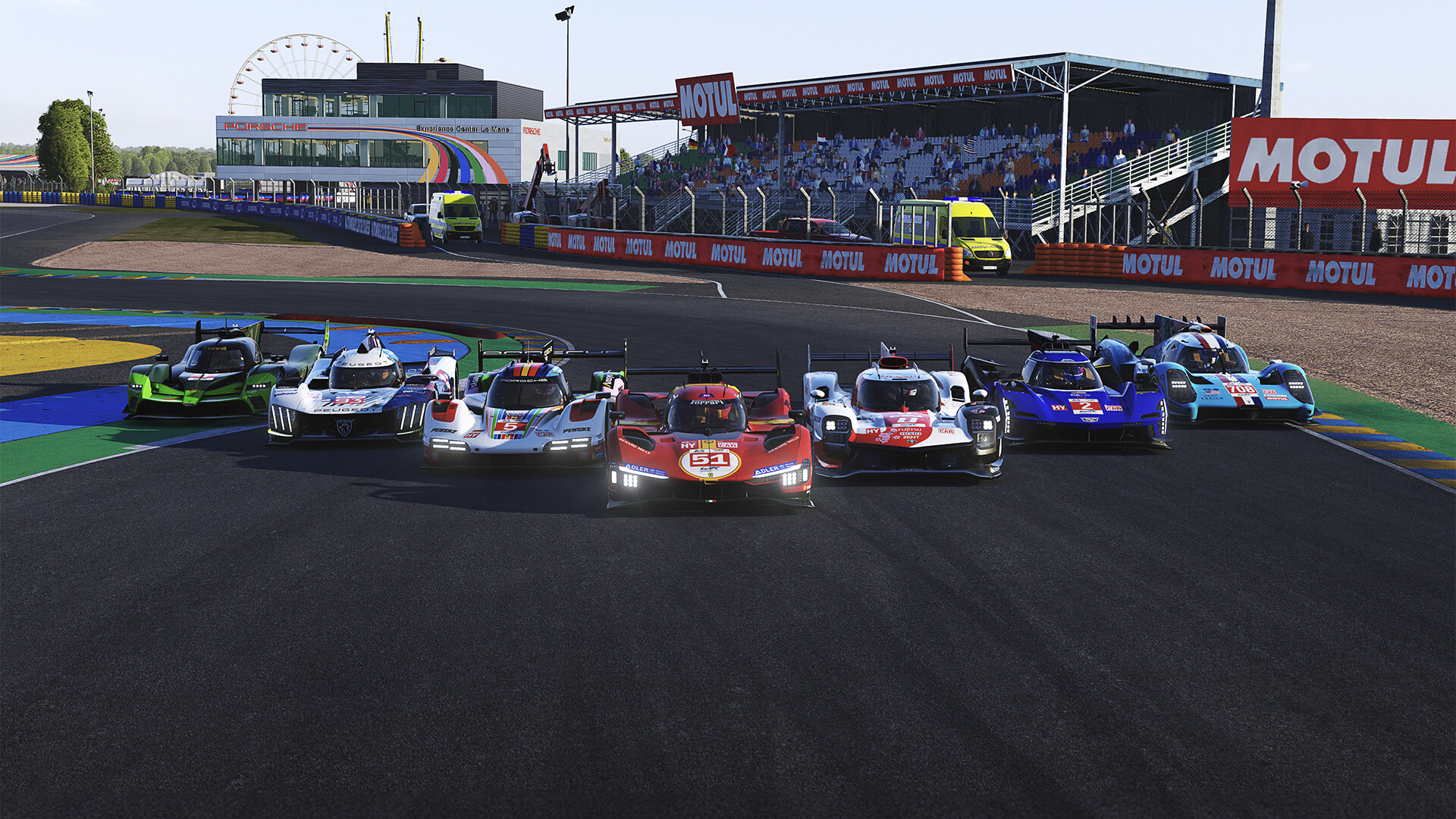
The Hypercar class is the pinnacle of endurance racing, featuring advanced hybrid and non-hybrid prototypes competing in the FIA WEC. Within this class are two distinct types:
- LMH
- Fully manufacturer-developed cars.
- Flexible design regulations allowing hybrid and non-hybrid systems.
- Examples: Toyota GR010 Hybrid, Ferrari 499P.
- LMDh
- Combines manufacturer powertrains with standardized chassis from approved suppliers.
- Mandatory hybrid systems.
- Examples: Porsche 963, BMW M Hybrid V8.
Advanced Hybrid Management:
- The hybrid system aims to increase fuel efficiency, not outright speed.
- Energy from regenerative braking charges the battery, which is then deployed to reduce fuel consumption by supplementing the internal combustion engine.
- Avoid keeping the battery fully charged, as it prevents regenerative braking, leading to poorer brake performance and overheating.
- Aim to balance battery use strategically across each lap to maximize fuel economy and braking effectiveness.
Virtual Energy Explained:
- Virtual Energy (NRG) is the total energy you’re allowed to use per stint—this combines battery (hybrid) and fuel power and varies by car and circuit .
- Draining the NRG gauge to 0 incurs a 100-second stop-and-go penalty, with steeper penalties for repeat offenses.
- Monitoring and strategically using your hybrid deployment to stay within energy allowances is crucial.
- Adjusting the Fuel Ratio determines how much fuel is carried during your stint vs NRG
LMH vs LMDh Hybrid Differences
- Both classes are capped at a combined output of 500 kW / 671 bhp.
- LMH hybrids can deploy up to 200 kW and usually feature front-axle MGU with four-wheel-drive above certain speeds.
- Not all LMH cars have a hybrid system (e.g. Aston Martin Valkyrie, Glickenhaus. Vanwall) - but all LMDh cars do.
- LMDh use a spec MGU limited to 50 kW, used on the rear-axle only.
- The MGU doesn’t increase total power, it replaces ICE (Internal Combustion Engine) torque, keeping you under the 671 bhp limit - it increases efficiency so you carry lest fuel per stint.
Hybrid Setup & Strategy
Regenerative Braking (“Regen Level”)
Increase regen to harvest more energy under braking, improving both brake performance and battery refilling.
Battery Deployment (“Electric Motor Map”)
Higher map = more battery used under acceleration.
Avoiding Common Mistakes
- Don’t let battery reach 100% - regeneration stops and you lose braking efficiency = additional chance of locking your wheels.
- Don’t hit 0% battery before a pit stop - especially in LMDh, or you may be stranded (they use the battery for pitlane power).
- Stay within NRG limits - exceeding it causes major penalties.
- Avoid overfilling fuel - extra fuel adds weight without extra energy budget.
Driving Tips:
- Master hybrid deployment timing for optimal fuel savings.
- Prioritize managing tyre wear and fuel strategies.
- Anticipate traffic and utilize superior straight-line speed effectively.
- Always maintain partial battery charge to benefit from regenerative braking consistently.
23
17
Was this article helpful?
20 out of 23 found this helpful
Articles in this section
- What is multiclass racing?
- Driving Assists
- Understanding the HUD (Heads Up Display)
- Understanding the MFD (Multi Function Display)
- What is Virtual Energy? (NRG)
- What are limited tyres?
- Race Starts & Start Penalties – Formation Lap Rules Explained
- What is RealRoad? (RR)
- How do I configure my traction control in Le Mans Ultimate?
- ABS (Anti-Lock Braking System) for LMGT3 Cars